CSCA Physics December 2025 Past Paper
All 46 questions from CSCA Physics December 2025 Past Paper, each with the correct answer and a worked solution — free to read.
Want to actually sit it — timed, graded, saved to your notebook?
Sign in (free) to take this exam interactively. Your score, wrong answers and weak topics are tracked in your wrong-answer notebook and learning center.
Do this exam freeCSCA Physics December 2025 Past Paper · #1· Topic: 标量与矢量
Which of the following physical quantities is not a vector? ()
- A.Magnetic flux density
- B.Momentum
- C.Electric field strength
- Correct answer: D.Potential energy
Show solution(Answer: D)
1 A vector has magnitude and direction; potential energy is a scalar quantity.
CSCA Physics December 2025 Past Paper · #2· Topic: 其他星球表面的重力加速度
The gravitational force acting on an object on Mars is of the gravitational force acting on it on Earth. Therefore, the gravitational force acting on an object of mass on Mars is ( ), ( )
- A.144 N
- B.24 N
- C.48 N
- Correct answer: D.16 N
Show solution(Answer: D)
1 Mars weight is one-third of Earth weight: .
2 Compute: .
CSCA Physics December 2025 Past Paper · #3· Topic: 胡克定律
A spring with elasticity constant is stretched from its original length of 10 cm to 15 cm under a force . The magnitude of the force is ().
- Correct answer: A.5 N
- B.25 N
- C.10 N
- D.15 N
Show solution(Answer: A)
1 Use Hooke's law: F=k x.
2 Extension .
3 .
CSCA Physics December 2025 Past Paper · #4· Topic: 静摩擦力的大小计算
[Editorial revision] An object of mass rests on a horizontal surface. The coefficient of kinetic friction is . After a horizontal pulling force of 2 N is applied, the object remains at rest. What is the magnitude of the frictional force on the object?
- Correct answer: A.2 N
- B.3 N
- C.4 N
- D.6 N
Show solution(Answer: A)
The object remains at rest, so the net horizontal force is zero. Static friction balances the 2 N pull and acts in the opposite direction. Its magnitude is 2 N, so A is correct. The kinetic friction coefficient does not determine the actual static friction. Editorial note: the original resting-object description conflicted with its kinetic-friction solution; this revision explicitly states that the object remains at rest after the force is applied.
CSCA Physics December 2025 Past Paper · #5· Topic: 合力的取值范围
An object is acted upon by three forces with magnitudes . The maximum magnitude of the resultant force acting on the object is ( ).
- Correct answer: A.12 N
- B.0 N
- C.10 N
- D.24 N
Show solution(Answer: A)
1 The maximum resultant occurs when all forces act in the same direction.
2 .
CSCA Physics December 2025 Past Paper · #6· Topic: 牛顿第二定律
On a smooth horizontal surface, an object of mass undergoes uniformly accelerated linear motion from rest under the action of a horizontal pulling force . If its displacement within 2 seconds is 8 m , then the magnitude of the horizontal pulling force is ().
- A.10 N
- B.6 N
- Correct answer: C.8 N
- D.2 N
Show solution(Answer: C)
1 From rest with constant acceleration: a .
2 .
3 .
CSCA Physics December 2025 Past Paper · #7· Topic: 匀变速直线运动速度与时间的关系
An object on a smooth horizontal surface begins uniform accelerated linear motion from rest. If its acceleration is , then its velocity at the end of 4 seconds is ().
- A.
- B.
- Correct answer: C.
- D.
Show solution(Answer: C)
1 Uniform acceleration from rest: .
2 .
CSCA Physics December 2025 Past Paper · #8· Topic: 自由落体运动的规律及应用
An object falls freely from a height of 100 m above the ground. At the end of 4 s, its height above the ground is ( ). ()
- A.45 m
- B.10 m
- C.80 m
- Correct answer: D.20 m
Show solution(Answer: D)
1 Free fall distance: .
2 Height remaining .
CSCA Physics December 2025 Past Paper · #9· Topic: 无外力,物体在光滑斜面滑动
An object of mass is placed on a long, smooth inclined plane with an inclination angle . Starting from rest, the object slides down the plane. The distance traveled in 2 s is ( ). ()
- A.5 m
- B.1 m
- Correct answer: C.10 m
- D.2 m
Show solution(Answer: C)
1 Along a smooth incline: .
2 Distance in 2 s from rest: .
CSCA Physics December 2025 Past Paper · #10· Topic: 牛顿第二定律
Two forces acting on an object with a mass of 2 kg have magnitudes of 6 N and 8 N , respectively. The maximum acceleration of this object is ( ).
- A.
- Correct answer: B.
- C.
- D.
Show solution(Answer: B)
1 Maximum net force occurs when the two forces are in the same direction: .
2 .
CSCA Physics December 2025 Past Paper · #11· Topic: 磁感应强度的定义(式)
A straight conductor 0.5 m long is placed perpendicular to a uniform magnetic field. When a current of 10 A flows through it, the force exerted on the conductor is 1.5 N . The magnitude of the magnetic field's magnetic induction is ( )
- Correct answer: A.0.3 T
- B.0.2 T
- C.0.1 T
- D.0.4 T
Show solution(Answer: A)
1 Magnetic force on a straight conductor: .
2 .
CSCA Physics December 2025 Past Paper · #12· Topic: 线速度与角速度的关系
A point moves in uniform circular motion with a speed of . The radius of the circular path is . The angular velocity of the point is ().
- A.
- B.
- Correct answer: C.
- D.
Show solution(Answer: C)
1 For uniform circular motion: .
CSCA Physics December 2025 Past Paper · #13· Topic: 平均速度
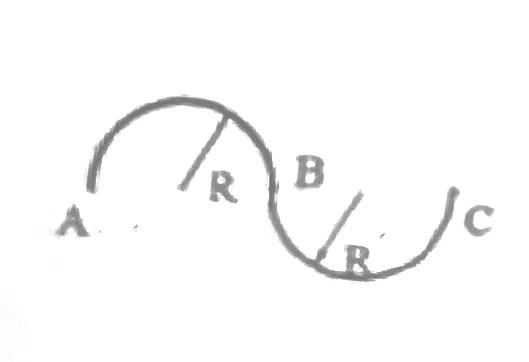
As shown in the figure, an object moves from point through point to point along two semicircles with radius , taking a time of . The magnitude of its average velocity is ().
- Correct answer: A.
- B.
- C.
- D.
Show solution(Answer: A)
1 Displacement is the straight line from A to C. The two semicircles each have diameter , so the displacement is .
2 Average velocity , option A.
3 Note: the path length is , so (option D) is the average speed, not the average velocity.
CSCA Physics December 2025 Past Paper · #14· Topic: 路程与位移
Which of the following statements about distance and displacement is correct?
- A.Distance is a vector, displacement is a scalar.
- Correct answer: B.The magnitude of displacement is not necessarily equal to the magnitude of path length
- C.Both path and displacement are vectors
- D.The magnitude of displacement is always equal to the distance traveled.
Show solution(Answer: B)
Distance is a scalar and displacement is a vector, so A and C are false. Displacement magnitude is no greater than distance traveled. They are equal for motion along a straight line without reversal, but can differ otherwise. Therefore B is correct and D is false.
CSCA Physics December 2025 Past Paper · #15· Topic: 计算物体的动量及动量的变化
An object with mass moves with constant velocity on a smooth horizontal surface. The magnitude of its momentum is ().
- A.
- Correct answer: B.
- C.
- D.
Show solution(Answer: B)
1 Momentum .
CSCA Physics December 2025 Past Paper · #16· Topic: 求恒力的冲量
An object of mass is placed on a smooth inclined plane with an angle and height 20 m . Starting from rest, the object slides down. The magnitude of the gravitational impulse experienced by the object within 2 s is ( ) . ( )
- A.
- B.
- C.
- Correct answer: D.
Show solution(Answer: D)
1 Gravitational force is constant: .
2 Impulse from gravity over .
CSCA Physics December 2025 Past Paper · #17· Topic: 平均速度
The displacement x of a toy car moving along a straight line is plotted against time t in the figure. Which statement is correct?
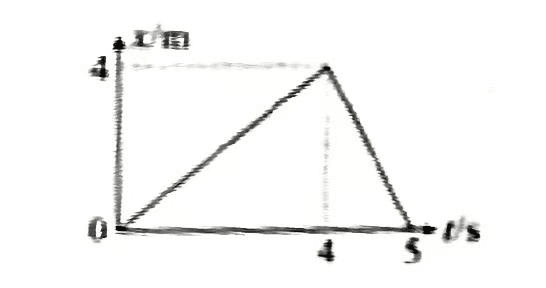
- A.Between 0 and 4 s , the displacement of the toy car is 8 m
- B.From 4 s to 5 s , the magnitude of the toy car's velocity is
- Correct answer: C.From 0 s to 4 s , the magnitude of the toy car's velocity is
- D.From 0 to 5 seconds, the average velocity of the toy car is
Show solution(Answer: C)
From the x-t graph, displacement increases from 0 to 4 m over , so speed is slope . Other statements conflict with the graph (wrong displacement, wrong slope, or wrong average velocity).
CSCA Physics December 2025 Past Paper · #18· Topic: 功的计算
A horizontal pulling force F of 20 N is applied to an object of mass 10 kg . The object moves 5 m on a rough horizontal surface with a friction force . The work done by the pulling force is ( ).
- Correct answer: A.100 J
- B.75 J
- C.- 25 J
- D.25 J
Show solution(Answer: A)
1 Work by the pulling force: .
CSCA Physics December 2025 Past Paper · #19· Topic: 动能定理的初步应用
A ball of mass moves on a smooth horizontal surface. An external force changes its speed from to . The work done by the external force is ( ).
- A.54 J
- B.60 J
- Correct answer: C.48 J
- D.6 J
Show solution(Answer: C)
1 Work-energy theorem: .
2 .
3 .
CSCA Physics December 2025 Past Paper · #20· Topic: 光的折射定律
When light enters a medium from air, the angle of incidence and the angle of refraction . If the refractive index of air is , then the refractive index of the medium is ( ).
- A.
- Correct answer: B.
- C.
- D.1.5
Show solution(Answer: B)
1 Snell's law: .
2 .
CSCA Physics December 2025 Past Paper · #21· Topic: 简谐运动的定义及特征
A spring-mass system undergoes simple harmonic motion. The time taken for one complete oscillation is 2 seconds. The frequency of this spring-mass system is ( ).
- A.2 Hz
- Correct answer: B.0.5 Hz
- C.0.2 Hz
- D.5 Hz
Show solution(Answer: B)
1 Frequency .
CSCA Physics December 2025 Past Paper · #22· Topic: 频率和波速的关系
A sound wave with frequency propagates through air at a speed . The wavelength of this sound wave is ( ).
- Correct answer: A.1.7 m
- B.3.4 m
- C.6.8 m
- D.680 m
Show solution(Answer: A)
1 Wavelength .
CSCA Physics December 2025 Past Paper · #23· Topic: 库仑定律内容和表达式
In a vacuum, two point charges separated by a distance exert a mutual force of magnitude . If the distance between the two point charges remains unchanged but the charge on one of them is doubled, the Coulomb force between them becomes approximately ( ) times the original force.
- Correct answer: A.2 times
- B.4 times
- C.
- D.
Show solution(Answer: A)
1 Coulomb force . Doubling one charge doubles F.
CSCA Physics December 2025 Past Paper · #24· Topic: 自由落体运动的规律及应用
The magnitude of the velocity of a water droplet falling from a height of 5 m to the ground with an initial velocity of zero is ( ) ( )
- Correct answer: A.
- B.
- C.
- D.
Show solution(Answer: A)
1 From rest: .
CSCA Physics December 2025 Past Paper · #25· Topic: 根据电场线的疏密比较电场强弱
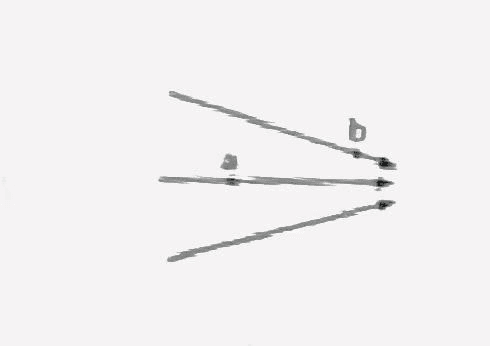
The electric field lines of an electric field are distributed as shown in the figure. If point charges and of equal charge are placed at points a and b in the field, the relationship between the electric forces exerted on the two point charges is ( ),
- A.
- B.
- Correct answer: C.
- D.
Show solution(Answer: C)
1 Electric force on a test charge: .
2 Field strength is larger where field lines are denser; point is in the denser region than point a (from the diagram).
3 So > , i.e., <.
CSCA Physics December 2025 Past Paper · #26· Topic: 电阻的串联与并联
The total resistance when two resistors of and are connected in parallel is ( ).
- A.
- B.
- C.
- Correct answer: D.
Show solution(Answer: D)
1 Parallel resistors: .
2 .
CSCA Physics December 2025 Past Paper · #27· Topic: 电阻的串联与并联
Two resistors, and , are connected in parallel across a voltage . The ratio of the currents through them, , is ( ).
- A.
- B.
- C.
- Correct answer: D.
Show solution(Answer: D)
1 In parallel, each resistor has the same voltage ( 12 V ).
2 .
3 Ratio .
CSCA Physics December 2025 Past Paper · #28· Topic: 理想气体的状态方程的理解及初步应用
For an ideal gas of constant mass, when the temperature remains unchanged and the pressure decreases, its volume ( )
- A.remains unchanged
- B.decrease
- C.All of the above are possible
- Correct answer: D.Increase
Show solution(Answer: D)
1 For an ideal gas at constant temperature (isothermal): constant.
2 If pressure decreases, volume must increase.
CSCA Physics December 2025 Past Paper · #29· Topic: 电场强度的定义和单位
A point charge is placed in an electric field of strength . The magnitude of the electric force on the charge is ( ).
- Correct answer: A.
- B.
- C.
- D.
Show solution(Answer: A)
1 Electric force: .
2 .
CSCA Physics December 2025 Past Paper · #30· Topic: 磁感应强度的定义(式)
The international units for magnetic flux density and magnetic flux are respectively ( ).
- Correct answer: A.Tesla, Weber
- B.Ampere, Volt
- C.Pascal, Hertz
- D.Joule, Watt
Show solution(Answer: A)
1 Magnetic flux density B has unit Tesla (T). Magnetic flux has unit Weber (Wb).
CSCA Physics December 2025 Past Paper · #31· Topic: 光的反射定律
[Editorial revision] A ray of light enters the interface between glass and air from air at an angle of incidence of . The angle between the reflected ray and the incident ray is ( ).
- A.
- B.
- Correct answer: C.
- D.
Show solution(Answer: C)
The angle of reflection equals the angle of incidence, 30 degrees. The incident and reflected rays lie on opposite sides of the normal, so the angle between them is 60 degrees. C is correct. Editorial note: the source had 60 degrees for both C and D. Option D has been rewritten as 90 degrees to provide a unique answer; it is an editorial distractor, not a recovered original option.
CSCA Physics December 2025 Past Paper · #32· Topic: 安培力的计算式及初步应用
A wire of length carries a steady current I in a uniform magnetic field . If the maximum magnetic force on the wire is , the current I is ( ).
- Correct answer: A.0.5 A
- B.5 A
- C.0.2 A
- D.2A
Show solution(Answer: A)
1 Maximum magnetic force on a wire: .
2 .
CSCA Physics December 2025 Past Paper · #33· Topic: 理想气体的状态方程的理解及初步应用
An ideal gas of a certain mass undergoes an isobaric process (constant pressure) from state A to state B. Given that the volume of state A is and its temperature is , while the temperature of state B is , the volume of state B is ( ).
- A.
- B.
- Correct answer: C.
- D.
Show solution(Answer: C)
For a fixed mass of ideal gas at constant pressure, . Thus exactly. Option C is correct.
CSCA Physics December 2025 Past Paper · #35· Topic: 动量守恒定律的初步应用
A small ball with a mass of 20 kg collides with a stationary cart on a smooth horizontal surface at a speed of . Given that the cart has a mass of 40 kg , the combined speed of the ball and cart after the collision is ( ).
- Correct answer: A.
- B.
- C.
- D.
Show solution(Answer: A)
1 Perfectly inelastic collision (stick together): conserve momentum.
2 .
CSCA Physics December 2025 Past Paper · #36· Topic: 重力势能的变化和重力做功的关系
Question: A basketball with mass bounces from the ground to a height before falling back to the ground. The change in gravitational potential energy during this entire process is ( ).
- A.10 J
- B.0.5 J
- C.5 J
- Correct answer: D.0 J
Show solution(Answer: D)
1 Initial and final positions are both on the ground, so gravitational potential energy change over the whole bounce cycle is .
2 Therefore the net change in gravitational potential energy is 0 J .
CSCA Physics December 2025 Past Paper · #37· Topic: 利用平衡推论求力大小或方向
A thin rope is fixed at point O and supports a ball A of mass . A horizontal pulling force holds the ball at rest with the rope at to the vertical. The horizontal pulling force is ( ). ()
- A.
- B.12 N
- Correct answer: C.
- D.20 N
Show solution(Answer: C)
1 At equilibrium: vertical component of tension balances weight: .
2 .
3 Horizontal pulling force equals .
CSCA Physics December 2025 Past Paper · #38· Topic: 电场强度的叠加法则
[Editorial revision] Two fixed point charges in vacuum carry and and are separated by . Given , what is the magnitude of the electric field at the midpoint of the line joining the charges?
- A.
- B.
- Correct answer: C.
- D.
Show solution(Answer: C)
The midpoint is from each charge. Both fields point from the positive charge toward the negative charge, so their magnitudes add: . C is correct. Editorial note: the source stem was incomplete and its charge magnitude conflicted with the solution. This version reconstructs the point-charge model, charge magnitude and midpoint question used in the solution; it is not a recovery of the original wording.
CSCA Physics December 2025 Past Paper · #39· Topic: 平抛运动速度的计算
A small ball is thrown horizontally from a building of height with an initial speed of . Neglecting air resistance, the magnitude of the ball's velocity when it hits the ground is ( )
- A.
- Correct answer: B.
- C.
- D.
Show solution(Answer: B)
1 Horizontal projectile: time to fall .
2 Horizontal speed stays ; vertical speed at impact .
3 Resultant speed , option B.
CSCA Physics December 2025 Past Paper · #40· Topic: 线速度与角速度的关系
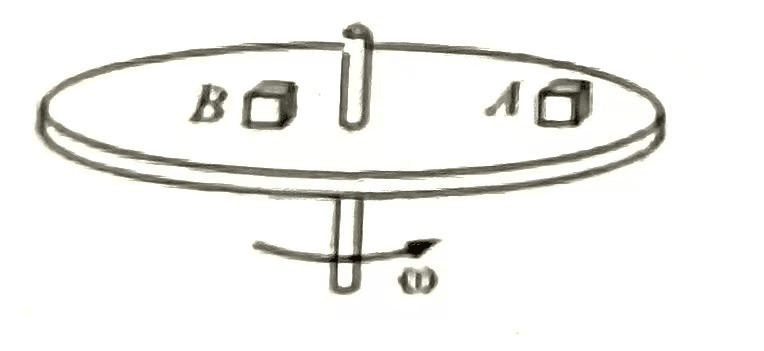
As shown in the figure, two objects A and B of equal mass are placed on a horizontal disk rotating uniformly about a vertical axis. Both objects remain stationary relative to the disk. Then, the two objects ( ).
- Correct answer: A.have the same angular velocity
- B.Object A has a greater angular velocity than object B
- C.A's angular velocity is less than B's angular velocity
- D.The same linear velocity
Show solution(Answer: A)
1 Objects fixed on the same rotating disk share the same angular velocity .
2 Linear (tangential) speed differs if r differs, so only must be the same.
CSCA Physics December 2025 Past Paper · #41· Topic: 计算电势差的大小
A point charge with a charge of is moved from point A to point B in an electric field. The electric force does negative work of . The potential difference between points and is ( ).
- Correct answer: A.- 200 V
- B.200 V
- C.- 2000 V
- D.2000 V
Show solution(Answer: A)
1 Work done by electric force: .
2 .
CSCA Physics December 2025 Past Paper · #42· Topic: 库仑定律内容和表达式
Identical conductors A and B, treated as point charges, carry charges and and are separated by a distance . They are brought into contact and then returned to their original positions. The magnitude of the Coulomb force becomes what multiple of its original magnitude?
- A. times
- B.4 times
- C.8 times
- Correct answer: D. times
Show solution(Answer: D)
1 Initial O .
2 After contact, total charge ; identical conductors share equally each has .
3 .
4 Ratio .
CSCA Physics December 2025 Past Paper · #43· Topic: 应用动能定理解决多段过程问题
A bullet traveling horizontally at penetrates the first fixed wooden board, reducing its velocity to . If allowed to continue through the second identical board after penetrating the first, the bullet's velocity becomes ( ).
- A.
- Correct answer: B.
- C.
- D.
Show solution(Answer: B)
1 Assume each identical board removes the same kinetic energy (does the same work).
2 After first board: .
3 After second: .
4 .
CSCA Physics December 2025 Past Paper · #44· Topic: 动量定理的内容
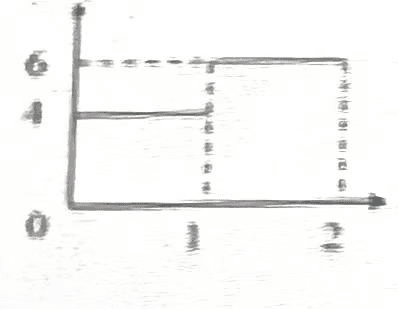
An object of mass is initially at rest on a smooth horizontal surface. A horizontal force F varies with time as shown. What is the kinetic energy of the object at the end of 2 s?
- Correct answer: A.25 J
- B.16 J
- C.36 J
- D.50 J
Show solution(Answer: A)
Impulse is the area under the force-time graph: . Since the object starts from rest, and . Option A is correct.
CSCA Physics December 2025 Past Paper · #45· Topic: 平抛运动位移的计算
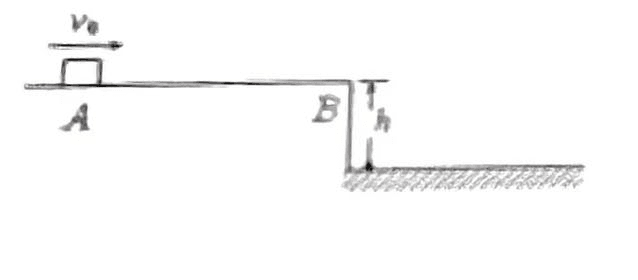
As shown in the figure, the height of the horizontal platform above the ground is 0.80 m . A block starts moving from point A with an initial velocity v , moving in a straight line with constant deceleration on the platform. The coefficient of kinetic friction between the block and the platform is .After reaching point B at the edge of the platform, the block flies off horizontally. Given 2.2 m , the horizontal distance from the block's landing point to the platform edge is ( ) .
- A.3 m
- B.1.5 m
- C.1 m
- Correct answer: D.2 m
Show solution(Answer: D)
1 On the platform, acceleration .
2 Use .
3 Fall time from height .
4 Horizontal distance .
CSCA Physics December 2025 Past Paper · #46· Topic: 导体棒切割磁感线的感应电流
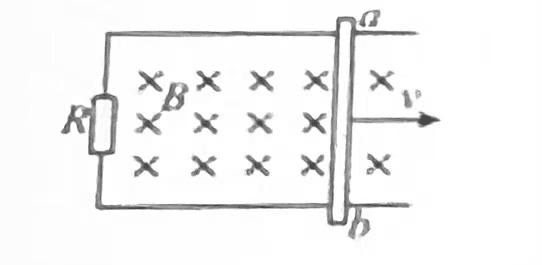
As shown, two horizontal parallel metal rails are connected by a resistor R at one end. Rod ab can slide without friction on the rails. A uniform magnetic field is perpendicular to the plane of the frame. When ab moves to the right at constant speed, which statement is correct?
- A.Once wire ab reaches a certain speed, removing the external force will allow wire ab to maintain uniform motion on the frame.
- B.If the resistance R is increased while wire ab maintains a constant speed, the force required to pull wire ab can be doubled.
- C.The greater the speed of wire segment ab, the smaller the required pulling force.
- Correct answer: D.In addition to the pulling force, the wire ab also experiences a magnetic field force.
Show solution(Answer: D)
1 A sliding rod in a magnetic field induces an emf BLv, producing current .
2 The rod experiences a magnetic force opposite the motion, so an external pull is needed for uniform speed.
3 Thus statement (D) is correct.
CSCA Physics December 2025 Past Paper · #47· Topic: 带电粒子在匀强电场中做直线运动
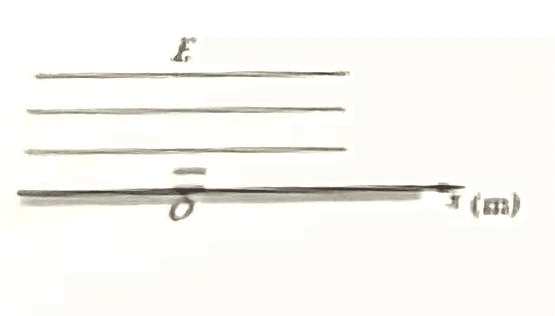
As shown in the figure, a uniform electric field in the horizontal direction exists on a horizontal tabletop. A small object of mass and charge is placed at point O on the tabletop and released from rest. Given that the sliding friction force between the object and the tabletop is , and the electric force acting on the object is directed to the right.Then, the work done by the net external forces on the object within 2 seconds after release from rest is ( ).
- A.3.2 J
- Correct answer: B.0.8 J
- C.2.4 J
- D.1.6 J
Show solution(Answer: B)
1 Net force: (to the right).
2 Acceleration: .
3 after .
4 Work by net external force equals .
More free answer walkthroughs
- Humanities Chinese Mock Exam 1
- Humanities Chinese Mock Exam 2
- Humanities Chinese Mock Exam 3
- Humanities Chinese Mock Exam 4
- Humanities Chinese Mock Exam 5
- Humanities Chinese Mock Exam 6
- Humanities Chinese Mock Exam 7
- Humanities Chinese Mock Exam 8
- STEM Chinese Mock Exam 1
- STEM Chinese Mock Exam 2
- STEM Chinese Mock Exam 3
- STEM Chinese Mock Exam 4
- STEM Chinese Mock Exam 5
- STEM Chinese Mock Exam 6
- STEM Chinese Mock Exam 7
- STEM Chinese Mock Exam 8
- CSCA Math December 2025 Past Paper
- CSCA Chemistry December 2025 Past Paper
- CSCA Humanities Chinese December 2025 Past Paper
- CSCA STEM Chinese January 2026 Past Paper