速度sùdù
Core Concept
Velocity (速度) is the rate at which position changes. In Chinese physics texts the word covers two distinct English ideas, and CSCA questions exploit the difference constantly:
- Speed (速率) — a scalar: how fast, no direction
- Velocity (速度) — a vector: how fast and in which direction
Average Velocity
Note that this uses displacement , not distance travelled. That single distinction generates most of the exam traps on this topic.
Average Speed
A runner completing one lap of a track in has:
- Average speed =
- Average velocity = , because they finished where they started
Instantaneous Velocity
The velocity at one instant — the limit of as . This is what a speedometer reads, and what "at the velocity is…" refers to.
For uniform acceleration, instantaneous velocity follows:
A Useful Shortcut
Under uniform acceleration only, the average velocity equals the mean of the endpoints:
This turns many two-step problems into one line. It is not valid when acceleration varies.
CSCA Practice Problems
💡 Note: These problems follow the CSCA exam syllabus and Chinese standardized test formats.
Example 1: Basic (Difficulty ★★☆☆☆)
A car travels east in , then back west in . Over the whole trip:
Options:
- A. average speed , average velocity
- B. average speed , average velocity
- C. average speed , average velocity
- D. average speed , average velocity
Detailed Solution:
-
Total distance = ; total time = .
-
The car ends where it began, so displacement :
Answer: B
Example 2: Intermediate (Difficulty ★★★☆☆)
A body starts from rest and accelerates uniformly, reaching after travelling . How long did it take?
Options:
- A.
- B.
- C.
- D.
Detailed Solution:
Use the average-velocity shortcut instead of solving for first:
-
Uniform acceleration from rest, so
-
Then
Answer: B
Check the long way: , then ✓ — same answer, twice the work.
Common Mistakes
❌ Mistake 1: Using distance in the average-velocity formula
uses displacement. Any closed loop gives zero average velocity no matter how far the object actually travelled.
❌ Mistake 2: Averaging two speeds directly
For equal distances at and , the average speed is not — it is the harmonic mean , because more time is spent at the slower speed. Averaging endpoints is valid only for uniform acceleration over equal time.
❌ Mistake 3: Treating velocity as always positive
Velocity is a vector; a negative value simply means motion in the negative direction.
Study Tips
- ✅ Ask "distance or displacement?" before every average calculation
- ✅ Memorise and the condition it needs (uniform acceleration)
- ✅ Watch for closed paths — round trips are a giveaway that average velocity is
- ✅ Keep speed and velocity separate even though Chinese uses 速率 and 速度 closely
- ✅ Label your positive direction and let negative values do their job
💡 Exam Tip: 平均速度 and 瞬时速度 are both recurring CSCA knowledge points, and 路程和位移的计算 sits right beside them — most questions are really testing whether you noticed the distance-versus-displacement switch.
How the real exam tests it
Questions from real CSCA papers that test this term. Work each one out before you open the answer.
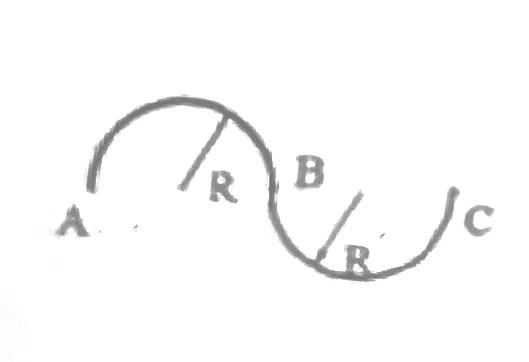
- CSCA Physics December 2025 Past PaperAs shown in the figure, an object moves from point through point to point along two semicircles with radius , taking a time of . The magnitude of its average velocity is ().
- A.
- B.
- C.
- D.
See it in the full CSCA Physics December 2025 Past PaperShow answer & solution
Answer: A
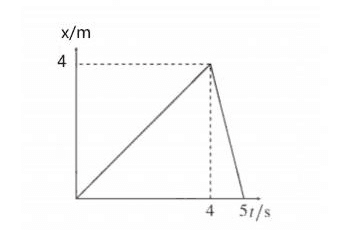
1 Displacement is the straight line from A to C. The two semicircles each have diameter , so the displacement is . 2 Average velocity , option A. 3 Note: the path length is , so (option D) is the average speed, not the average velocity. - CSCA Physics March 2026 Past PaperThe x-t graph for a toy car in linear motion is shown. Which statement is correct?
- A.Displacement from is 8 m
- B.Velocity from is
- C.Average velocity from is
- D.Velocity from is
Take the full CSCA Physics March 2026 Past Paper — timed & gradedShow answer & solution
Answer: B
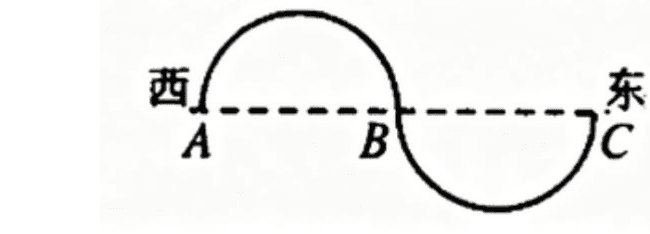
From graph: goes from 0 to 4 m linearly. A: displacement is 4 m , not 8 . , correct. C: at 5 s position returns to 0 , average velocity . D: , displacement in 1 s , speed . Answer: B. - CSCA Physics April 2026 Past PaperAs shown in the figure, an object travels along a path consisting of two semicircles end-to-end (each of radius 4 m ) from through to . Points are collinear along the east-west direction. The travel takes 2 s . The magnitude of the average velocity is
- A.
- B.
- C.
- D.
Take the full CSCA Physics April 2026 Past Paper — timed & gradedShow answer & solution
Answer: D
Each semicircle has diameter , so . Because , are collinear, the total displacement is . Average velocity .
Related Terms
Prerequisites — learn these first
Related terms — better learned together
Practice Exercises
Practice to reinforce your understanding