位移wèiyí
Core Concept
Displacement (位移) is the straight-line change in position: it points from where you started to where you finished, and nothing about the route in between matters.
Its partner concept is distance (路程) — the total length of the actual path travelled. 路程和位移的计算 is a high-frequency CSCA knowledge point precisely because students conflate the two.
Definition
- Vector (矢量): has magnitude and direction
- SI unit: metre ()
- Can be positive, negative, or zero
Displacement vs Distance
| Displacement 位移 | Distance 路程 | |
|---|---|---|
| Type | vector | scalar |
| Depends on path? | no | yes |
| Can be zero while moving? | yes | no |
| Relationship | distance | always |
The two are equal only when the motion is in a straight line without reversing direction. Every other case has distance strictly greater.
Two Dimensions
Displacement adds like any vector. Perpendicular legs combine by the Pythagorean theorem:
Walking east then north: distance , displacement north-east.
Reading It Off a Graph
On a position–time graph, displacement over an interval is the change in height between the endpoints.
On a velocity–time graph, displacement is the signed area under the curve — area below the axis counts as negative. Distance, by contrast, is the total unsigned area. This is the single most useful graph fact in CSCA kinematics.
CSCA Practice Problems
💡 Note: These problems follow the CSCA exam syllabus and Chinese standardized test formats.
Example 1: Basic (Difficulty ★★☆☆☆)
An athlete runs one and a half laps of a circular track of circumference . The distance and the magnitude of the displacement are:
Options:
- A. and
- B. and about
- C. and
- D. and
Detailed Solution:
-
Distance is the path length: .
-
One and a half laps ends diametrically opposite the start, so the displacement is one diameter.
-
From : , so the diameter is about .
Option D is the trap for treating half a lap ( of arc) as the displacement — but displacement is the straight line, not the arc.
Answer: B
Example 2: Intermediate (Difficulty ★★★☆☆)
A body moves at for , then at for . Find its displacement and the distance travelled.
Options:
- A. displacement , distance
- B. displacement , distance
- C. displacement , distance
- D. displacement , distance
Detailed Solution:
-
First leg:
-
Second leg:
-
Displacement adds the signed contributions:
-
Distance adds the magnitudes:
On a velocity–time graph this is exactly signed area versus total area.
Answer: A
Common Mistakes
❌ Mistake 1: Using distance where displacement belongs
and both produce displacement. Feeding them distance breaks any problem involving a reversal.
❌ Mistake 2: Adding path segments that point in opposite directions
Two moves in opposite directions give displacement , not .
❌ Mistake 3: Taking the arc as the displacement on a circular track
Displacement is always the straight chord between endpoints.
❌ Mistake 4: Ignoring sign when reading a velocity–time graph
Area below the time axis is negative displacement. Summing all areas as positive gives distance, not displacement.
Study Tips
- ✅ Underline "distance" or "displacement" in the question before computing anything
- ✅ Sketch the path — one drawing settles most of these questions
- ✅ Remember distance, with equality only for straight-line, no-reversal motion
- ✅ On a – graph: signed area = displacement, total area = distance
- ✅ Combine perpendicular legs with Pythagoras, not by adding
💡 Exam Tip: 路程和位移的计算 is among the top CSCA physics knowledge points. Questions almost always include a reversal or a closed loop — that is the whole test.
How the real exam tests it
Questions from real CSCA papers that test this term. Work each one out before you open the answer.
- CSCA Physics March 2026 Past PaperIf a projectile's initial velocity is tripled, then
- A.Flight time triples
- B.Horizontal displacement triples
- C.Landing speed unchanged
- D.Vertical displacement triples
Take the full CSCA Physics March 2026 Past Paper — timed & gradedShow answer & solution
Answer: B
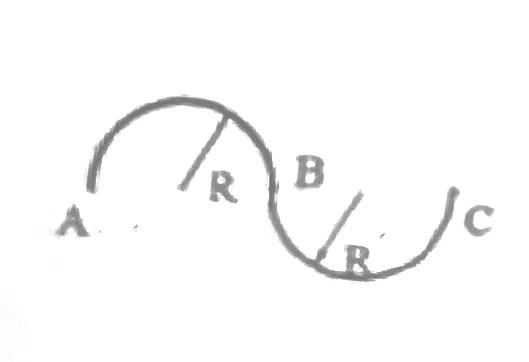
Flight time : depends on height only (A wrong). Vertical displacement depends on and only (D wrong). : tripling v triples . Vertical component unchanged but horizontal increases → landing speed increases (C wrong). Answer: B. - CSCA Physics December 2025 Past PaperAs shown in the figure, an object moves from point through point to point along two semicircles with radius , taking a time of . The magnitude of its average velocity is ().
- A.
- B.
- C.
- D.
See it in the full CSCA Physics December 2025 Past PaperShow answer & solution
Answer: A
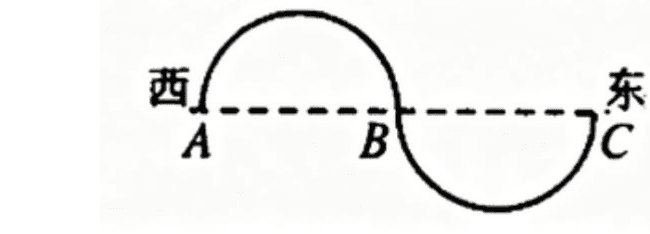
1 Displacement is the straight line from A to C. The two semicircles each have diameter , so the displacement is . 2 Average velocity , option A. 3 Note: the path length is , so (option D) is the average speed, not the average velocity. - CSCA Physics April 2026 Past PaperAs shown in the figure, an object travels along a path consisting of two semicircles end-to-end (each of radius 4 m ) from through to . Points are collinear along the east-west direction. The travel takes 2 s . The magnitude of the average velocity is
- A.
- B.
- C.
- D.
Take the full CSCA Physics April 2026 Past Paper — timed & gradedShow answer & solution
Answer: D
Each semicircle has diameter , so . Because , are collinear, the total displacement is . Average velocity .
Related Terms
Related terms — better learned together
Practice Exercises
Practice to reinforce your understanding