Velocity and Acceleration
速度与加速度
Average versus instantaneous velocity, the defining equation for acceleration and its vector nature, and how change in velocity relates to acceleration.
Formulas
Average velocity
DefinitionApplies when:Δx is the displacement; average velocity is a vector along the displacement
Definition of acceleration
DefinitionApplies when:Directed along the change in velocity Δv, not necessarily along the velocity itself
How the real exam tests it
Questions from real CSCA papers that test this concept. Work each one out before you open the answer.
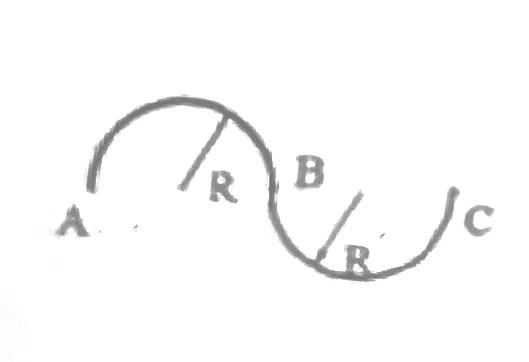
- CSCA Physics December 2025 Past PaperAs shown in the figure, an object moves from point through point to point along two semicircles with radius , taking a time of . The magnitude of its average velocity is ().
- A.
- B.
- C.
- D.
See it in the full CSCA Physics December 2025 Past PaperShow answer & solution
Answer: A
1 Displacement is the straight line from A to C. The two semicircles each have diameter , so the displacement is . 2 Average velocity , option A. 3 Note: the path length is , so (option D) is the average speed, not the average velocity. - CSCA Physics March 2026 Past PaperThe x-t graph for a toy car in linear motion is shown. Which statement is correct?
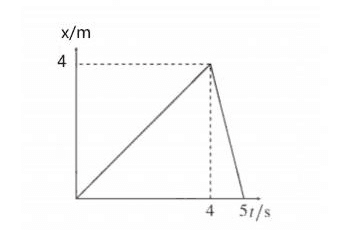
- A.Displacement from is 8 m
- B.Velocity from is
- C.Average velocity from is
- D.Velocity from is
Take the full CSCA Physics March 2026 Past Paper — timed & gradedShow answer & solution
Answer: B
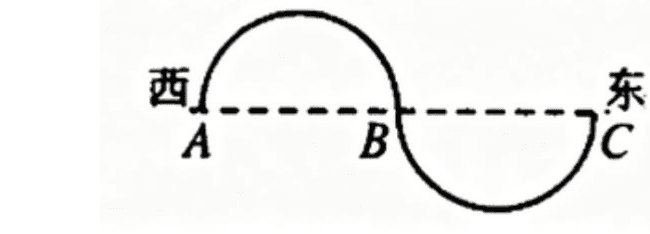
From graph: goes from 0 to 4 m linearly. A: displacement is 4 m , not 8 . , correct. C: at 5 s position returns to 0 , average velocity . D: , displacement in 1 s , speed . Answer: B. - CSCA Physics April 2026 Past PaperAs shown in the figure, an object travels along a path consisting of two semicircles end-to-end (each of radius 4 m ) from through to . Points are collinear along the east-west direction. The travel takes 2 s . The magnitude of the average velocity is
- A.
- B.
- C.
- D.
Take the full CSCA Physics April 2026 Past Paper — timed & gradedShow answer & solution
Answer: D
Each semicircle has diameter , so . Because , are collinear, the total displacement is . Average velocity .
Real-exam evidence
Recorded past-paper appearances are listed below; online verification is labelled separately.
- CSCA Physics April 2026 Past Paper1 questionreading page not yet public
- CSCA Physics March 2026 Past Paper1 questionreading page not yet public
- CSCA Physics January 2026 Past Paper1 questionreading page not yet public
- CSCA Physics December 2025 Past Paper3 questionsView question 10 and answer free (full paper)View question 13 and answer free (full paper)View question 17 and answer free (full paper)
15 questions across 6 mock papers — our own papers, so a coverage signal rather than real-exam evidence
7 related practice questions availablePractise free: Kinematics
Sitting evidence comes from the CSCA past papers on record; questions whose original paper is missing are excluded, and sprint papers are deliberately not counted.