Electric Field and Field Strength
电场与电场强度
Coulomb's law and charge conservation, the defining equation and superposition of electric field strength, the fields of a point charge and a uniform field, and what field-line density means.
Formulas
Coulomb's law
LawApplies when:Point charges in vacuum; k is the electrostatic constant
Definition of electric field strength
DefinitionApplies when:A ratio definition: E is set by the field itself, not by the test charge q
Field of a point charge
FormulaApplies when:A point charge in vacuum. Outside a uniformly charged shell or solid sphere the field is the same as if all the charge sat at the centre; inside they differ — the field is zero inside a shell (and inside a conductor in electrostatic equilibrium), but not inside a uniformly charged solid sphere
Field strength in a uniform field
FormulaApplies when:Uniform fields only; d is measured along the field direction
How the real exam tests it
Questions from real CSCA papers that test this concept. Work each one out before you open the answer.
- CSCA Physics December 2025 Past PaperThe electric field lines of an electric field are distributed as shown in the figure. If point charges and of equal charge are placed at points a and b in the field, the relationship between the electric forces exerted on the two point charges is ( ),
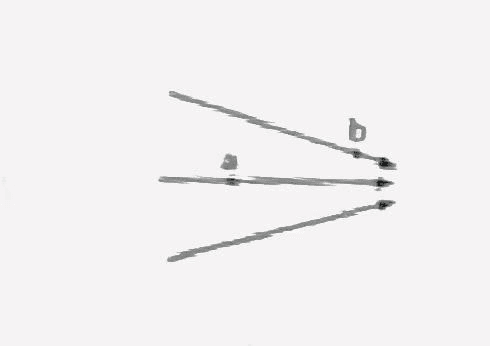
- A.
- B.
- C.
- D.
See it in the full CSCA Physics December 2025 Past PaperShow answer & solution
Answer: C
1 Electric force on a test charge: . 2 Field strength is larger where field lines are denser; point is in the denser region than point a (from the diagram). 3 So > , i.e., <. - CSCA Physics March 2026 Past PaperCharges at vertices of an equilateral triangle. A and B are positive. The resultant force on A from B and C is , with angle to BA extension . Which is correct about C ?
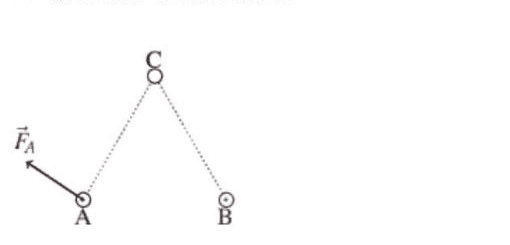
- A.Positive, charge < B
- B.Negative, charge
- C.Positive, charge > B
- D.Negative, charge < B
Take the full CSCA Physics March 2026 Past Paper — timed & gradedShow answer & solution
Answer: D
repels along extension. Resultant angle means slight deflection toward . If were positive, its repulsion would push the angle beyond - contradiction. So C is negative (attractive), deflecting toward CA.Angle means C 's attraction 's repulsion, so . Answer: D. - CSCA Physics April 2026 Past PaperA point charge produces an electric field of magnitude at point . If the distance from the charge to is doubled, the new electric field magnitude is
- A.
- B.
- C.
- D.
Take the full CSCA Physics April 2026 Past Paper — timed & gradedShow answer & solution
Answer: C
Since is inversely proportional to . Doubling reduces to of its original value.
Real-exam evidence
Recorded past-paper appearances are listed below; online verification is labelled separately.
- CSCA Physics April 2026 Past Paper4 questionsreading page not yet public
- CSCA Physics March 2026 Past Paper3 questionsreading page not yet public
- CSCA Physics January 2026 Past Paper4 questionsreading page not yet public
- CSCA Physics December 2025 Past Paper5 questionsView question 23 and answer free (full paper)View question 25 and answer free (full paper)View question 29 and answer free (full paper)View question 38 and answer free (full paper)View question 42 and answer free (full paper)
22 questions across 6 mock papers — our own papers, so a coverage signal rather than real-exam evidence
40 related practice questions availablePractise free: Electrostatics
Sitting evidence comes from the CSCA past papers on record; questions whose original paper is missing are excluded, and sprint papers are deliberately not counted.