Electromagnetic Induction
电磁感应
Magnetic flux and its change, the condition for and direction of an induced current (Lenz's law), Faraday's law of induction, and the emf of a rod cutting field lines.
Formulas
Definition of magnetic flux
DefinitionApplies when:Requires S perpendicular to B; otherwise use the component of B normal to S
Faraday's law of induction
LawApplies when:The emf follows the rate of change of flux, not the flux itself; direction by Lenz's law
Motional emf
FormulaApplies when:ε=BLv when B, L and v are mutually perpendicular; θ is the angle between v and B
How the real exam tests it
Questions from real CSCA papers that test this concept. Work each one out before you open the answer.
- CSCA Physics December 2025 Past PaperThe international units for magnetic flux density and magnetic flux are respectively ( ).
- A.Tesla, Weber
- B.Ampere, Volt
- C.Pascal, Hertz
- D.Joule, Watt
See it in the full CSCA Physics December 2025 Past PaperShow answer & solution
Answer: A
1 Magnetic flux density B has unit Tesla (T). Magnetic flux has unit Weber (Wb). - CSCA Physics April 2026 Past PaperIn a 50 -turn coil, the magnetic flux changes uniformly from 0.2 Wb to 0.6 Wb in 0.1 s . The induced EMF is
- A.200 V
- B.20 V
- C.100 V
- D.50 V
Take the full CSCA Physics April 2026 Past Paper — timed & gradedShow answer & solution
Answer: A
. - CSCA Physics March 2026 Past PaperParallel rails connected by R; wire ab slides frictionlessly in a perpendicular uniform field. When ab moves right at constant speed, which is correct?
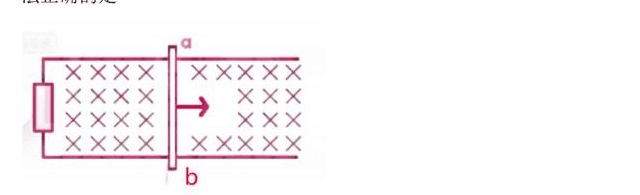
- A.Constant speed continues after removing force
- B.ab experiences both pulling force and Ampère force
- C.Increasing R increases pulling force
- D.Greater speed means smaller pulling force
Take the full CSCA Physics March 2026 Past Paper — timed & gradedShow answer & solution
Answer: B
Moving wire generates , current, and Ampère force opposing motion. Constant speed requires a pull to balance the Ampere force (B). A: removing force → deceleration. C: larger R → less current → less Ampère force → less pull needed. D: faster → larger more current → more Ampère force → more pull needed. Answer: B.
Real-exam evidence
Recorded past-paper appearances are listed below; online verification is labelled separately.
- CSCA Physics April 2026 Past Paper2 questionsreading page not yet public
- CSCA Physics March 2026 Past Paper3 questionsreading page not yet public
- CSCA Physics January 2026 Past Paper3 questionsreading page not yet public
- CSCA Physics December 2025 Past Paper2 questionsView question 30 and answer free (full paper)View question 46 and answer free (full paper)
19 questions across 6 mock papers — our own papers, so a coverage signal rather than real-exam evidence
23 related practice questions availablePractise free: Electromagnetic Induction
Sitting evidence comes from the CSCA past papers on record; questions whose original paper is missing are excluded, and sprint papers are deliberately not counted.